Train in the right zones.
Every session.

Why it matters
Most runners train too hard on easy days and not hard enough on key sessions.
Lactate testing removes the guesswork. Your unique physiology — not a generic formula — defines your training zones. The result is faster aerobic development, less junk mileage, and better race-day performance.
What is lactate threshold testing
The science behind your training zones
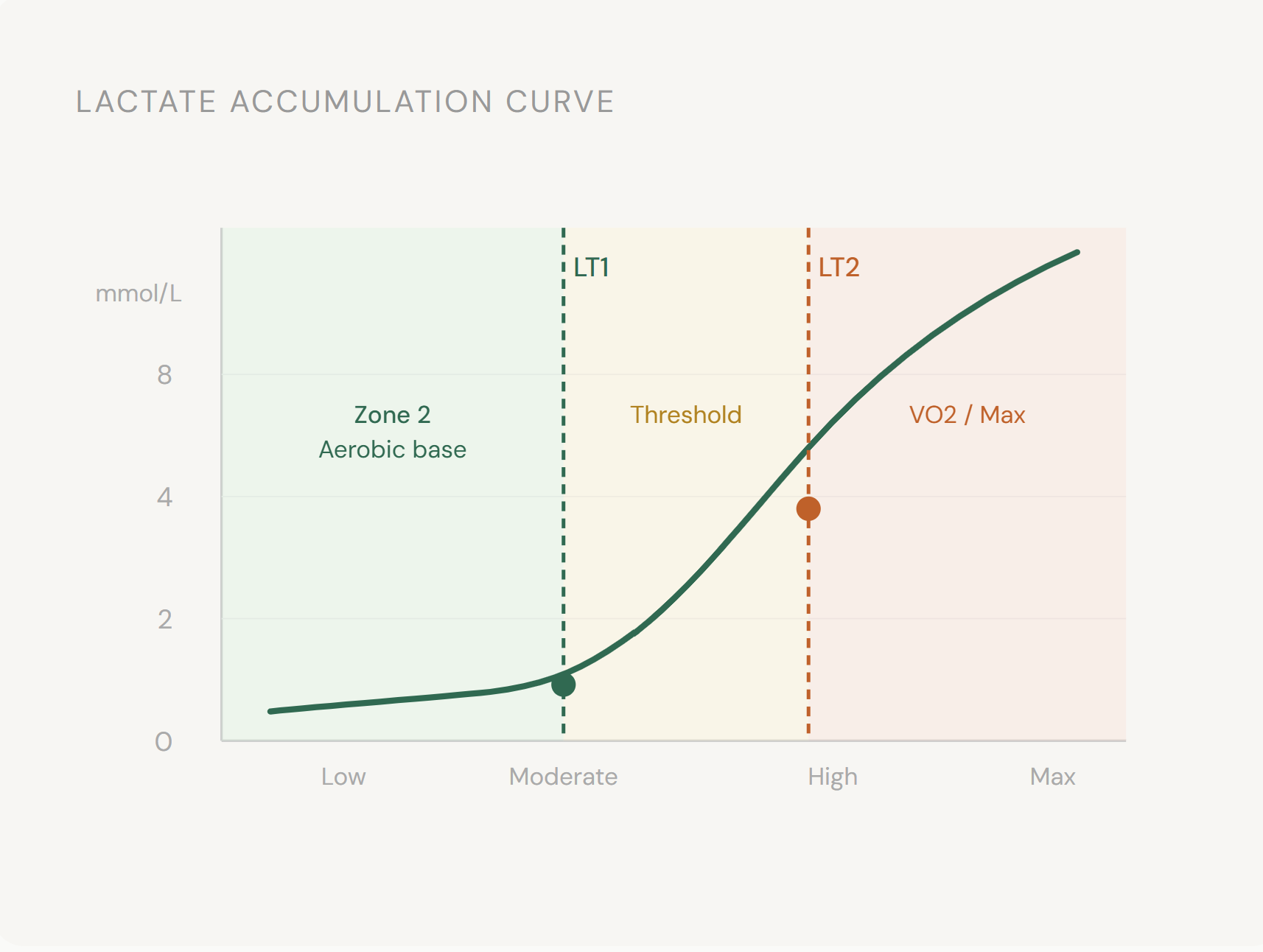
Lactate is a by-product of energy production. At low intensities, your body clears it as fast as it's produced. As intensity increases, lactate begins to accumulate — and two critical thresholds mark where this changes.
LT1 (Aerobic Threshold) is the intensity at which lactate begins to rise above baseline. Training below LT1 builds your aerobic base — the foundation of all endurance performance. This is Zone 2 in most systems.
LT2 (Lactate Threshold) is the highest intensity you can sustain before lactate accumulates faster than it can be cleared. This is your threshold pace — the upper limit of sustainable effort for 30–60 minutes.
A ramped lactate test maps these two points precisely for your body, on your sport — treadmill, bike trainer, or kayak ergometer. No estimation. No algorithm. Your actual physiology.
Lactate accumulation curve on the right
The testing process
How a ramped lactate test works
A lactate test is simple, safe, and takes around 25 - 45 minutes. Here's exactly what happens from first contact to training zones in your plan.
-
History & goal intake
We review your training history, current fitness level, race goals, and any available data — heart rate, GPS, previous test results. This shapes how we design the test stages and what we're looking for in your curve.
-
Easy start at low intensity
You begin at a comfortable pace — well below any threshold. This allows baseline lactate to stabilise and ensures the first stage reading is accurate. For most athletes this is a gentle jog, easy cycle, or light paddle.
-
Progressive intensity increase
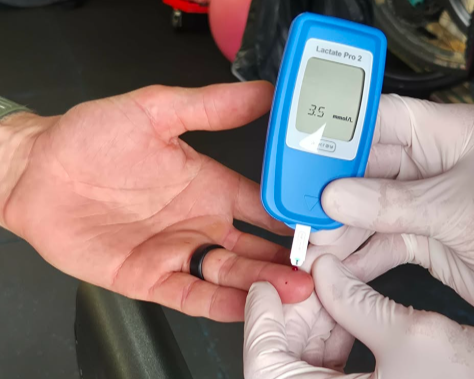
Every 4–6 minutes, intensity increases by a fixed increment. At the end of each stage, a small fingertip blood sample (0.5 µl) is taken and analysed immediately using a portable lactate analyser. Heart rate and RPE are recorded alongside each reading.
-
Plotting your lactate curve
Your lactate values are plotted against intensity to reveal the curve. LT1 is identified at the first meaningful rise from baseline — typically around 2 mmol/L. LT2 is the point where lactate rises steeply and becomes unsustainable, typically 4 mmol/L or where the exponential curve inflects.
-
Training zones delivered same day
Within 24 hours you receive your personalised zone report — pace, heart rate, and power at LT1 and LT2, your full lactate curve, and how these translate directly into your training sessions. No generic percentages. Your thresholds, your zones.
Stop guessing at your effort.
Lactate threshold testing reveals exactly where your aerobic base ends and your threshold begins — so every training session has a purpose.
·
·
No generic plans. No guesswork.
·
Built around your body, your life, and your goal
· · No generic plans. No guesswork. · Built around your body, your life, and your goal
-
![Geometric drawing of an outline square with sections divided by vertical, horizontal, and diagonal lines.]()
Greater Aerobic Base in Less Time
Training consistently below LT1 drives mitochondrial density, fat oxidation, and capillary development — the foundations of ultra endurance.
-
![Geometric drawing of an outline square with sections divided by vertical, horizontal, and half circle lines.]()
Reduced injury risk
Training too hard too often is the primary driver of overuse injury and overtraining syndrome. Accurate zones prevent this.
-
![Geometric drawing of an outline square with sections divided by vertical, horizontal, and circle lines.]()
Better recovery between sessions
Easy days at true Zone 1–2 intensity allow full recovery, so your hard sessions have maximum quality and adaptation stimulus.
-
![]()
Objective progress tracking
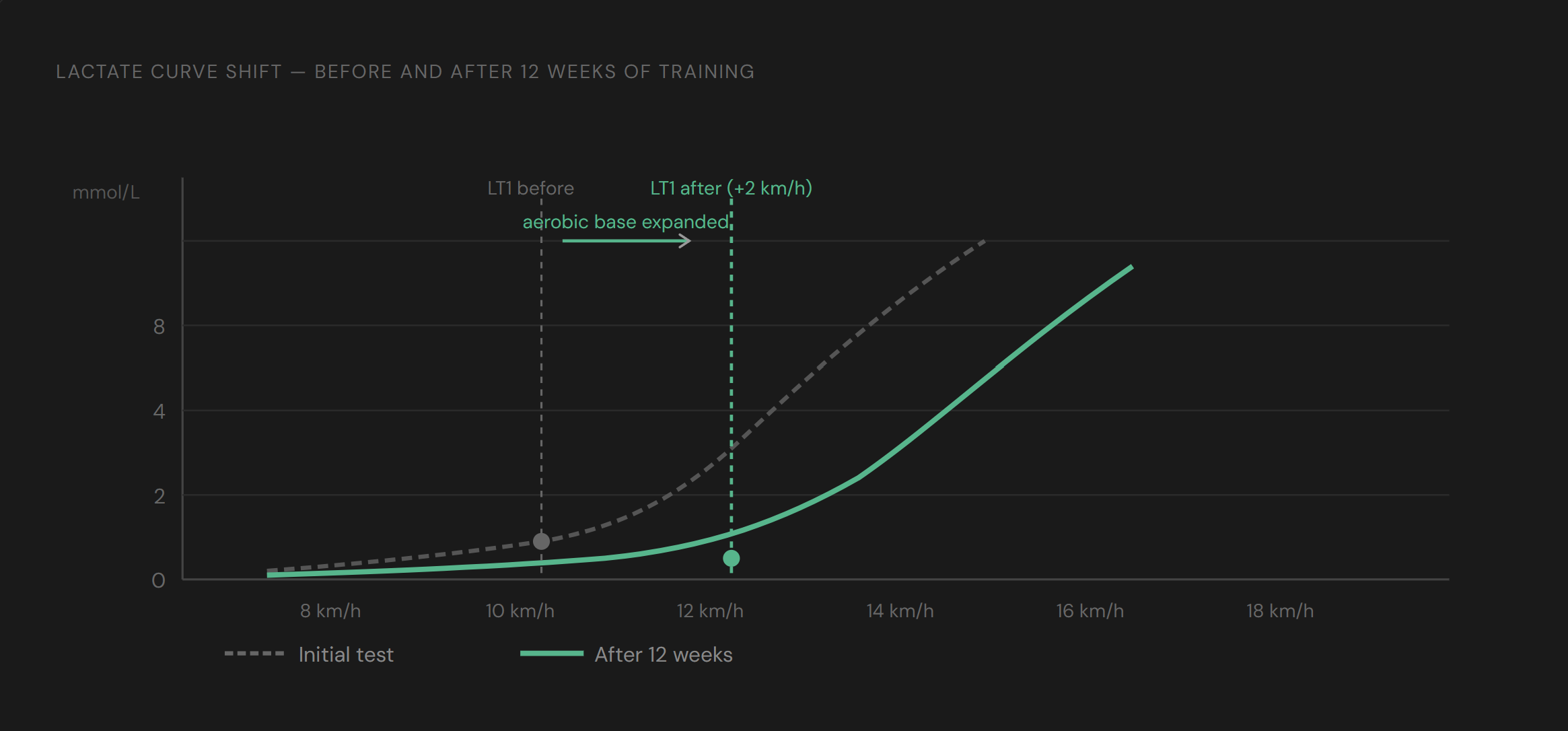
Retesting shows your LT1 and LT2 at higher speeds or watts over time — concrete evidence of improved fitness rather than subjective feel.
-
![]()
Race-specific preparation
Your target race pace sits in a known zone. We can structure training blocks to simulate race-day demands with precision.
-
![]()
Confidence in your training
When every session has a physiological purpose, you stop second-guessing. That certainty translates into consistent, motivated training.oes here






Weeks 2–8
Build phase
Training structured around confirmed zones. Weekly plan updates as fitness develops.
-
The fingertip prick is very small — similar to a diabetic blood glucose test. Most athletes don't find it uncomfortable. The exercise stages are progressively harder but you stop well before complete exhaustion.
-
Yes. A field test on a flat road or track is a valid alternative. We design the stages around your environment. The key is consistent, controllable intensity — which is achievable outdoors with a GPS watch and flat terrain.
-
A VO2 max test measures your maximum oxygen uptake — a useful ceiling number. A lactate test maps your thresholds across the full intensity range, which is more directly applicable to training zone design. Most athletes benefit more from knowing their LT1 and LT2 than their VO2 max.
-
Yes, testing is available to anyone.
Testing is most valuable when the results directly feed into your training plan and are tracked over successive tests — which is what our coaching structure provides.
-
Testing can be arranged with local sports science labs or physiology providers in your region. We coordinate the protocol, interpret the results, and integrate them into your training plan regardless of where you're based.
Week 8–12
Retest
Second lactate test. Curve compared to baseline. Zones updated. Progress quantified.
Ongoing
Repeat cycle
Regular retesting every 8–12 weeks ensures training always reflects your current physiology.
Frequently asked Questions:
Retesting
Your aerobic base will shift. We measure it.
A single test establishes your baseline. Retesting at regular intervals shows how your physiology has responded to training — and allows zones to be updated to match your new fitness level.
Week 1
Initial test
Baseline lactate curve established. LT1, LT2, and training zones confirmed
Ready to train with purpose?
We’ll build the fitness, durability, and confidence you need for your next goal.